
Writing a Competency Demonstration Report (CDR) for Engineers Australia (EA) is a crucial milestone for foreign engineers seeking a skilled migration visa to Australia. However, many engineers face a major dilemma when their best engineering achievements stem from a CDR confidential project, or an assignment governed by a strict Non-Disclosure Agreement (NDA).
If you are wondering whether you can use classified, proprietary, or defense-related experience for your migration skills assessment without breaching legal contracts, the answer is yes.
This guide explains how to prepare a compliant NDA Career Episode, safeguard confidential information, prevent plagiarism, and meet all Engineers Australia Migration Skills Assessment (MSA) requirements using proven frameworks.
What is a CDR Confidential Project and Why Does It Cause Concern?
A confidential project CDR submission involves writing a Career Episode based on engineering work protected by legal non-disclosure agreements (NDAs), intellectual property (IP) clauses, security clearances, or commercial secrecy agreements.
| Legal/NDA Requirements | Engineers Australia (EA) Requirements |
|---|---|
| Protect trade secrets and confidential information. | Focus on your individual technical contributions using “I” statements. |
| Anonymize client names and sensitive project details. | Demonstrate your personal engineering competencies. |
| Generalize confidential codes, specifications, and technical data. | Explain your engineering problem-solving methods and decisions. |
Engineers operating in sectors such as aerospace, defense electronics, biomedical technology, cybersecurity, oil and gas, or high-tech manufacturing often find themselves caught between two opposing constraints:
- Violating employer NDAs: Disclosing proprietary formulas, client identities, budget totals, internal source code, or unreleased product designs can lead to termination, legal liability, or breach of contract.
- Receiving an EA rejection: Submitting an overly vague, generalized report that fails to demonstrate specific engineering calculations, decision-making, and problem-solving steps leads directly to a rejected assessment or a downgrade of your ANZSCO occupational classification.
The key to addressing this challenge is demonstrating your personal engineering competency, as Engineers Australia evaluates your personal contributions and technical abilities rather than confidential company data.
EA Guidelines on Confidentiality and Proprietary Information
Engineers Australia respects corporate privacy, patent laws, and security classifications. Assessors require sufficient technical depth to verify that you applied engineering principles (such as mathematical calculations, modeling, risk assessment, and design modifications).
When writing a proprietary project episode, adhere to the following core principles:
- Focus on Methodologies over Specific Values: Replace proprietary product names with generic technical descriptors (e.g., use “a high-speed industrial microcontroller” instead of “Model X-9000 secret prototype”).
- Anonymize Entities: Use functional titles like “a multinational defense contractor” or “a tier-1 telecommunications provider” rather than naming confidential clients or government entities.
- Normalize Scaled Data: If specific performance results, flow rates, or financial figures are confidential, present them as normalized ratios, percentages, or generalized parameters (e.g., “improved thermal dissipation efficiency by 18%”) to demonstrate your engineering contributions without disclosing proprietary information.
- Focus on First-Person Action: EA demands first-person self-narrative (“I designed,” “I calculated,” “I investigated”). Redacting sensitive context does not prevent you from explaining your individual analytical process.
✅ If you need expert assistance in structuring your report to navigate complex NDAs, CDR Report Writers provides professional assistance tailored to Engineers Australia guidelines.
Step-by-Step Guide to Writing an NDA Career Episode
Writing a proprietary project episode requires balancing technical clarity with legal compliance. Below is the standard 4-section structure prescribed by Engineers Australia, adapted for confidential submissions.
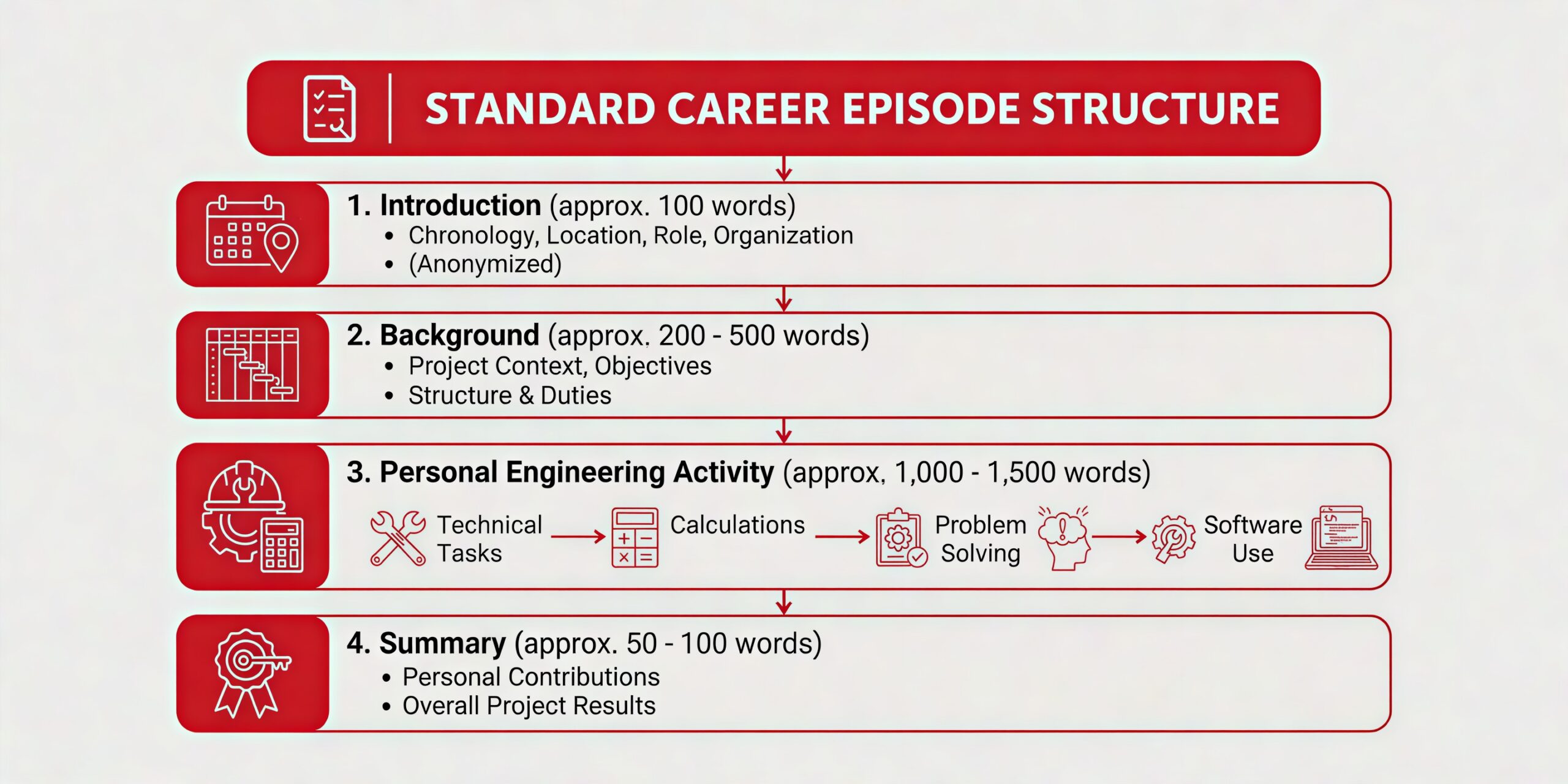
1. Section 1: Introduction
State the dates, location, organization, and your official designation. If the organization or location is restricted under an NDA, substitute the specific company name with a functional description.
- Example: “This career episode details my engineering activities while working as a Senior Systems Engineer at [Confidential Aerospace Enterprise] in [City, Country] from March 2023 to January 2025.”
2. Section 2: Background
Set the context of the project. Outline the broad engineering goals, the organizational hierarchy, and your designated responsibilities without revealing patented processes or trade secrets.
- What to include: Project scope, overall engineering objectives, team structure, direct supervisor title, and your official position description.
- How to keep it safe: Explain what the system was intended to do functionally rather than detailing how the unique IP is manufactured, programmed, or commercialized.
3. Section 3: Personal Engineering Activity
This is the main section of your episode. EA assessors look closely at this section to evaluate your core engineering competencies.
When working on a CDR confidential project, structure your narrative around engineering processes:
- Problem Identification: Describe a technical hurdle you encountered (e.g., signal attenuation, structural load imbalance, thermal overload).
- Engineering Principles Applied: Mention standard engineering formulas, international standards (e.g., ISO, IEEE, AS/NZS), and calculations used without referencing proprietary company algorithms.
- Tools and Software: List standard simulation and modeling tools used (e.g., MATLAB, ANSYS, AutoCAD, SolidWorks, Python).
- Personal Contribution: Maintain a first-person active voice (“I evaluated,” “I simulated,” “I mitigated”).
✨ For specialized support in writing compliant project narratives, explore CDR Report Writers’ Career Episode Writing Services, which help translate technical engineering tasks into EA-compliant content.
4. Section 4: Summary (50–100 words)
Summarize your personal achievements, engineering outcomes, and project success in generalized terms.
Comprehensive Abstraction Strategies Across Engineering Disciplines
Different engineering domains face distinct challenges when abstracting confidential information. Below are tailored strategies for specific disciplines:
1. Mechanical & Structural Engineering
- Confidential Element: Proprietary metallurgy, patented stress-bearing geometries, or secret manufacturing tolerances.
- Abstraction Strategy: Focus on standard Finite Element Analysis (FEA) methods, boundary conditions, loading scenarios, and governing physical laws (e.g., Hooke’s Law, Navier-Stokes equations). Frame structural improvements as percentage gains rather than disclosing absolute load capacities.
2. Software & Computer Engineering
- Confidential Element: Source code repositories, proprietary machine learning models, or trade-secret algorithms.
- Abstraction Strategy: Emphasize high-level system architecture, design patterns (e.g., Model-View-Controller, Microservices), standard protocols (e.g., REST, gRPC, MQTT), and algorithmic complexity analysis (Big-O notation). Explain why a specific data structure was selected over another without providing code snippets.
3. Electrical & Electronics Engineering
- Confidential Element: Classified circuit schematics, proprietary ASIC pinouts, or military signal processing techniques.
- Abstraction Strategy: Detail standard signal filtering techniques, power management logic, PCB layout constraints, EMI/EMC mitigation steps, and compliance with standards such as IEC or IEEE.
4. Chemical & Process Engineering
- Confidential Element: Patented catalyst formulas, secret reaction parameters, or trade-secret distillation ratios.
- Abstraction Strategy: Describe mass and energy balance calculations, heat exchanger sizing, pressure drop analysis, and hazard evaluation frameworks (e.g., HAZOP). Express reaction kinetics in terms of standard thermodynamic relationships.
🔥 To plan your visa application timeline effectively while drafting your report, check out our detailed guide on Engineers Australia CDR processing time.
Technical Anonymization Matrix: Before vs. After
To protect sensitive data while maintaining the technical depth required by Engineers Australia, use this reference matrix:
| Project Aspect | Confidential / Non-Compliant Input | EA-Compliant Anonymized Input |
|---|---|---|
| Client/Company | “Designed a tracking system for Defense Supplier X under Project Aegis.” | “Designed an automated tracking sub-assembly for a defense manufacturing project.” |
| Proprietary Software | “Used our internal in-house tool ‘AutoCalc-v4’ to process data.” | “Utilized standard numerical analysis methods via Python and MATLAB scripts to process data.” |
| Design Specifications | “Calculated the exact structural threshold of 45.23 kN for the confidential alloy.” | “Performed structural stress calculations on high-tensile material samples using finite element analysis (FEA).” |
| Calculations/Data | “The proprietary chemical formula produced a 98.4% purity yield.” | “Optimized process control parameters, resulting in a verified 12% increase in output purity.” |
| Project Location | “Deployed at Facility 4, Restricted Zone, Special Economic District.” | “Deployed at an industrial processing facility in an offshore commercial zone.” |
Common Pitfalls to Avoid in an NDA Career Episode
Writing a confidential project CDR requires avoiding key drafting errors that can trigger EA rejections or project delays:
The Critical CDR Pitfalls
| Critical CDR Pitfall | Potential Consequence |
|---|---|
| Excessive Redaction | Makes the Career Episode difficult to read and understand. |
| Using “We” Phrasing | Obscures your individual engineering contributions. |
| Omitting Mathematical Calculations | Makes it harder to verify your engineering analysis and technical decisions. |
| Unoriginal Text | Risks plagiarism concerns, assessment rejection, or other consequences under Engineers Australia’s policies. |
1. Excessive Redaction and Blacked-Out Text
Redacting key technical details completely (e.g., “I did [REDACTED] using [REDACTED] software”) makes your episode unreadable. Assessors cannot evaluate missing information. Replace sensitive terms with generic engineering descriptions instead.
2. Overemphasizing Teamwork
Writing “We designed the system” or “Our team executed the test plan” prevents the assessor from identifying your individual contributions.
3. Omitting Mathematical & Analytical Rigor
Engineers often assume that hiding confidential data means removing all calculations. This is a primary reason for rejection. You must still demonstrate how you calculated parameters, use generic variable symbols, and normalized values to prove your analytical process.
4. Ignoring Plagiarism Guidelines
Using templates or copying sample text from online sources will trigger EA’s plagiarism detection tools, leading to application rejections or bans. Every episode must be 100% original.
If you have already written your draft and want to verify its originality and compliance, use CDR Report Writers’ Review and Proofreading Services to ensure your report meets EA’s migration assessment standards before submission.
How to Cross-Reference a Confidential Project in the Summary Statement
The Summary Statement bridges your three Career Episodes with Engineers Australia’s core competency elements across Knowledge and Skill Base, Engineering Application Ability, and Professional and Personal Attributes.
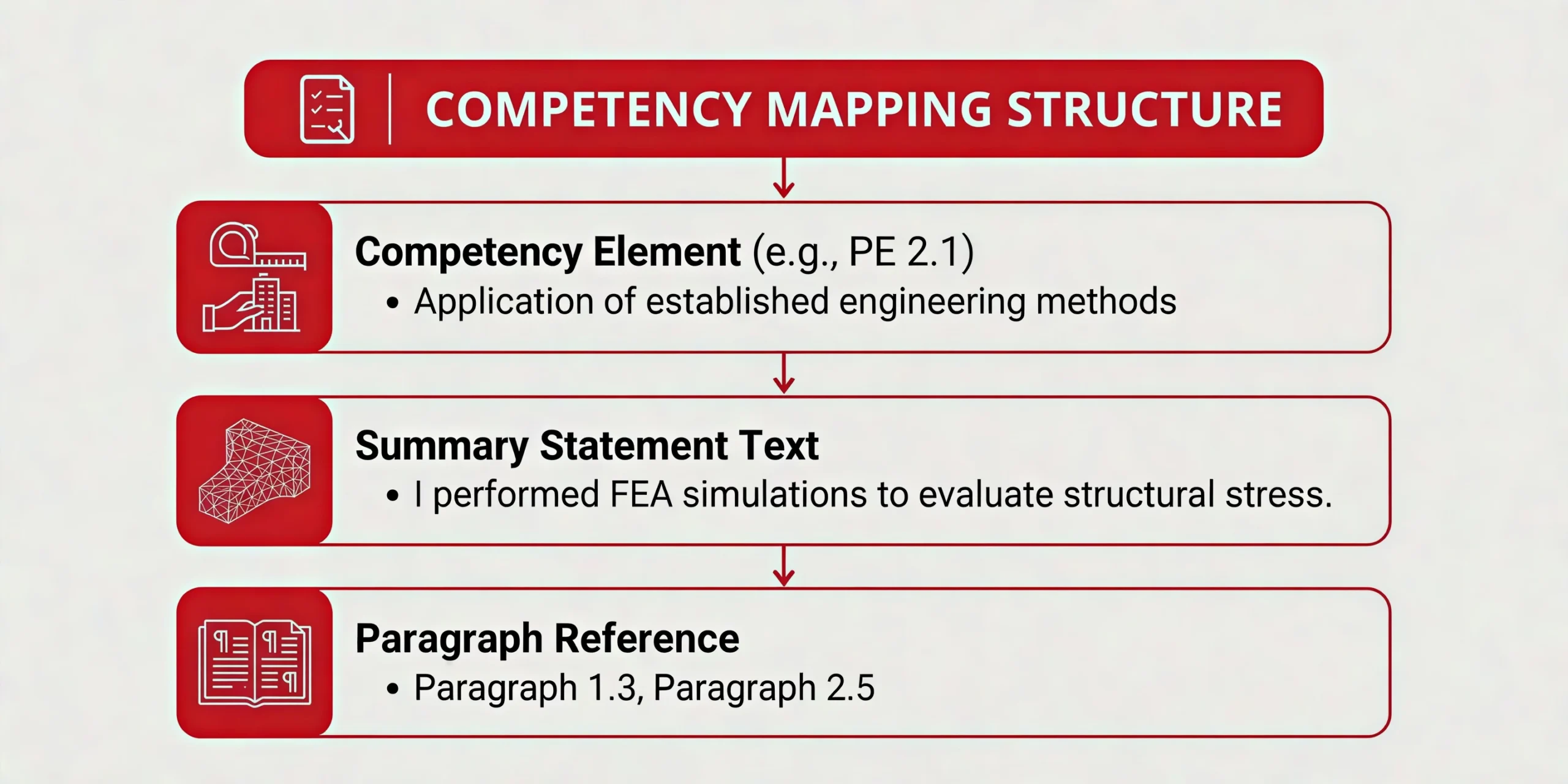
When linking a confidential project CDR episode to competency elements (such as PE1.3 “In-depth understanding,” PE2.1 “Application of engineering methods,” or PE2.2 “Fluent application of techniques”), reference the specific numbered paragraph where the action is described:
- Competency Element PE2.1: Application of established engineering methods to complex engineering problem solving.
- Summary Statement Text: “I used numerical stress analysis techniques to assess the stability of structural frames under varying load conditions.”
- Paragraph Reference: Paragraph 1.4, Paragraph 2.8
Anonymizing your project details does not impact your Summary Statement mapping, provided your paragraph references clearly detail the engineering actions you performed.
For a comprehensive overview of all assessment requirements, including Continuing Professional Development (CPD) and CV preparation, visit CDR Report Writers.
Navigating Verification and Employer References Under Strict NDAs
A common issue engineers face when writing a confidential project CDR is obtaining a detailed Employment Reference Letter from an employer that restricts disclosing project names on official letterheads.
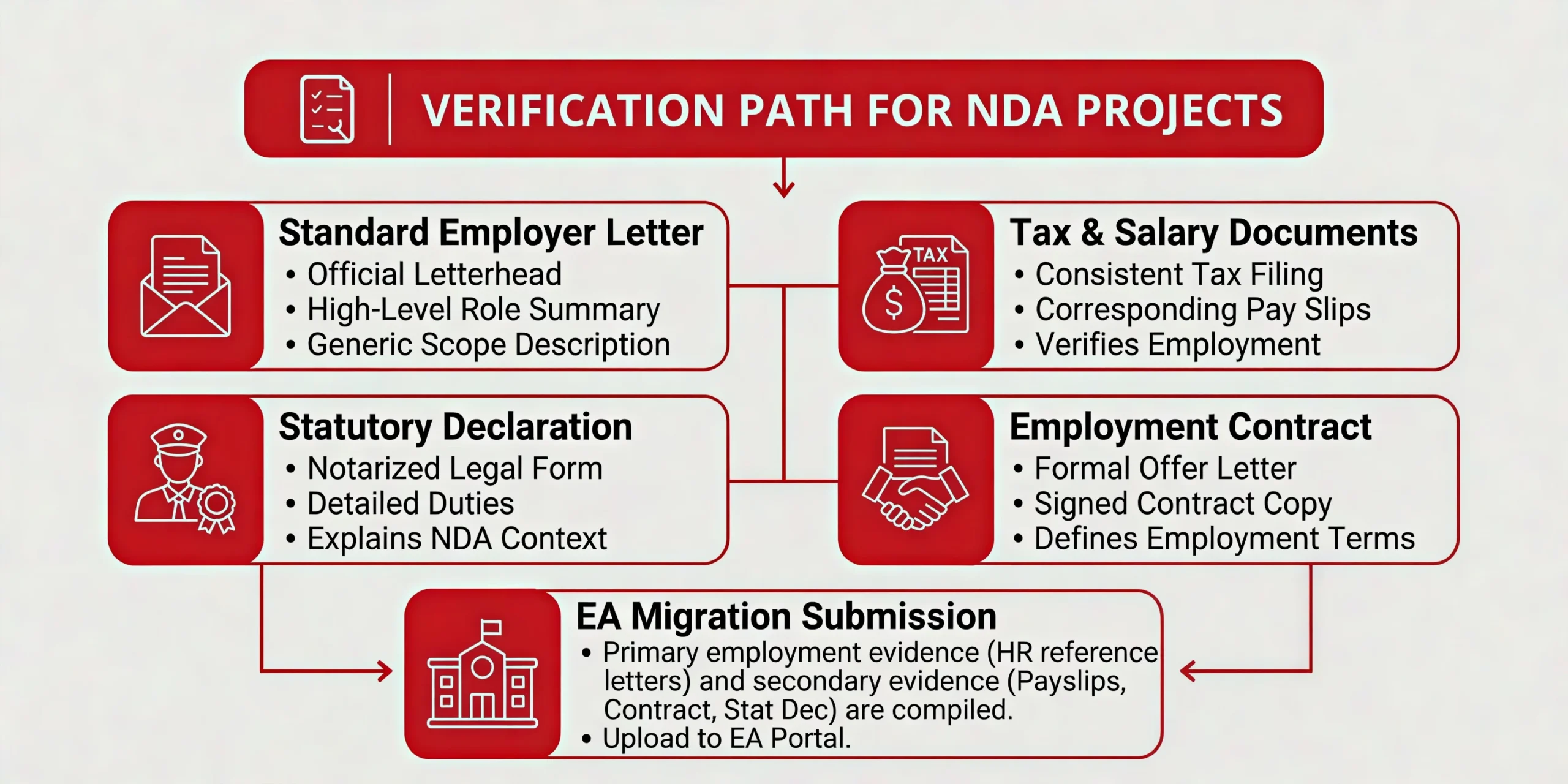
1. High-Level Employment Letters
Ask your HR department or manager to provide a broad reference letter that verifies your job title, dates of employment, hours worked per week, and a high-level list of generic core duties without listing sensitive project codes or client names.
2. Statutory Declarations
If your employer refuses to provide an official reference letter due to security protocols, Engineers Australia allows you to submit a legally binding Statutory Declaration. This document should explain your official duties, state that specific project names are protected under an NDA, and be notarized by an authorized legal authority.
3. Supporting Secondary Evidence
Always back up your reference documents with official secondary evidence, such as:
- Official employment contracts or appointment letters.
- Monthly payslips covering the start and end of the employment period.
- Government tax assessment records or social security contributions.
Conclusion
Drafting a CDR confidential project episode requires balancing technical clarity with non-disclosure obligations. By focusing on your personal engineering contributions, anonymizing proprietary parameters, and highlighting your problem-solving methodologies, you can present a strong, compliant report to Engineers Australia without violating your NDAs.
If you need professional guidance to ensure your report is fully compliant, error-free, and plagiarism-free, explore the full range of professional migration assessment services at CDR Report Writers to confidently start your skilled migration journey.
Frequently Asked Questions (FAQ)
1. Will Engineers Australia reject my CDR if I cannot share exact project drawings or client names?
No. Engineers Australia does not require proprietary CAD files, patented blueprints, or confidential client names. They focus on evaluating your personal application of engineering knowledge, analytical methodologies, and technical problem-solving skills.
2. Can I use an NDA Career Episode if I signed a defense or military contract?
Yes. Engineers working in defense, aerospace, or national security sectors frequently apply for Australian migration. You can describe your roles and engineering tasks using generalized, unclassified technical descriptions without disclosing sensitive operational details or security-cleared specifications.
3. Should I attach a copy of my Non-Disclosure Agreement (NDA) to my CDR submission?
No, Engineers Australia does not ask for or require copies of your legal NDAs. Simply ensure that the content within your Career Episodes is anonymized so that it complies with your contractual obligations while presenting clear engineering evidence.
4. How long should a Career Episode for a proprietary project be?
Engineers Australia specifies that each Career Episode should be between 1,000 and 2,500 words. Anonymized or confidential project episodes must fall within this same word count range.
5. What if my employer refuses to sign an Employment Reference Letter due to confidentiality?
If your employer cannot provide a detailed reference letter due to strict company policies, you may submit a notarized Statutory Declaration supported by secondary evidence, such as tax statements, salary slips, and employment records.
6. Can EA contact my employer to verify details under an NDA?
Engineers Australia reserves the right to verify employment claims. However, they typically verify basic employment parameters (such as employment period, job title, and general scope) rather than asking for protected intellectual property or trade secrets.