
Engineers Australia CDR Processing Time 2026 Standard vs Fast Track
Planning to migrate to Australia as an engineer is one of the most transformative professional moves you can make. However, securing a positive skills assessment from Engineers Australia (EA) stands as the absolute first and most critical milestone in this journey.
Whether you are an onshore applicant looking to secure vital points for your General Skilled Migration (GSM) visas, such as the Skilled Independent visa (subclass 189), Skilled Nominated visa (subclass 190), or an offshore candidate aiming for permanent residency, understanding the exact nuances of the Engineers Australia CDR processing time 2026 is vital to planning your overall migration timeline.
With dynamic shifts in skilled migration allocations, evolving Department of Home Affairs priority frameworks, and an unprecedented volume of international submissions, waiting periods can fluctuate dramatically throughout the year.
In this exhaustive 2026 guide, we break down every element of the Engineers Australia CDR processing time 2026, directly compare standard queues with EA fast track options, explore broader MSA processing time trends, evaluate key factors influencing your overall CDR assessment time, and explain how the expert engineering writers at CDR Report Writers can safeguard your dossier against expensive, time-consuming administrative delays.
1. The Critical Role of the Engineers Australia Skills Assessment
Engineers Australia is the designated assessing authority authorized by the Australian Government to evaluate engineering qualifications and work experience for migration purposes. For international engineering graduates whose undergraduate or postgraduate degrees were completed at institutions outside the jurisdiction of international engineering agreements, specifically the Washington Accord, Sydney Accord, or Dublin Accord, the Competency Demonstration Report (CDR) pathway is mandatory.
A Competency Demonstration Report is a comprehensive, technical submission that proves your engineering knowledge, problem-solving abilities, project management capabilities, and practical design experience meet Australian standards.
Because state nomination windows open unpredictably and occupational ceilings fill quickly during state invitation rounds, any unforeseen extension in your evaluation timeline can stall your Expression of Interest (EOI) or cause you to miss tight visa deadlines. Keeping a close eye on the Engineers Australia CDR processing time 2026 is therefore essential for every prospective migrant.
2. Comprehensive Analysis: Engineers Australia CDR Processing Time 2026
When you submit your Competency Demonstration Report through the EA portal, the duration it takes for evaluators to review your documentation depends heavily on total system queue volume, seasonal submission spikes, and the processing pathway you select.
In 2026, the Engineers Australia CDR processing time 2026 splits into two primary streams:
Engineers Australia CDR Assessment Timelines 2026
| Processing Pathway | Estimated Wait Time to Assessor Assignment |
|---|---|
| Standard CDR Pathway | 12–16 weeks (approximately 3–4 months) |
| EA Fast-Track Pathway | Within 20 business days (approximately 4 calendar weeks) |
The Standard Processing Queue
Under the standard submission path, applications enter a general queue. In 2026, standard processing times generally range from 12 to 16 weeks (roughly 3 to 4 months) merely to have an assessor assigned to your file.
During peak periods, such as the end of the Australian financial year or right after state nomination announcements, candidates often wait up to 15 weeks before an evaluator opens their application.
The Fast-Track Processing Queue
For applicants working against strict deadlines, Engineers Australia provides a premium priority option. The EA fast-track service ensures your application is allocated to a qualified assessor within 20 business days, equivalent to approximately four calendar weeks.
Crucial Note: It is important to distinguish between assessor assignment and final approval. The EA fast track option accelerates the time it takes for an official to start reviewing your file; it does not bypass technical checks or guarantee a positive result if your report contains flaws.
If your current subclass 485 Temporary Graduate visa is expiring, or if you must submit a positive assessment to lock in points before an upcoming birthday, relying on standard queues introduces severe risk. Preparing an error-free report with the help of CDR Report Writers using their dedicated CDR Writing Services prevents unexpected Clarification or More Information (MI) requests that halt processing clocks.
3. Standard vs. Fast Track: An In-Depth Comparison
Choosing between standard processing and priority evaluation depends on your budget, visa timeline, and strategic planning. Below is a detailed breakdown comparing both pathways in 2026:
| Comparison Metric | Standard CDR Processing Pathway | EA Fast Track Priority Pathway |
|---|---|---|
| Typical Duration | 12 to 16 Weeks | 20 Business Days (to assessor assignment) |
| Additional Priority Fee | None ($0) | ~AUD $396 (inclusive of GST where applicable) |
| Ideal Candidate Profile | Candidates with >6 months remaining on their current visa or those preparing far in advance. | Candidates facing impending visa expiration, tight state nomination windows, or age-point drops. |
| Primary Advantage | Most cost-effective route for early planners. | Drastically reduces waiting periods by up to 3 months. |
| Main Vulnerability | Long queue times mean any document request can push outcomes beyond 5 months. | High fees yield no benefit if poor documentation results in a request for info or rejection. |
Detailed Breakdown of Standard Processing
The standard route is ideal for applicants who are taking a long-term approach to their Australian migration. If you are currently in your final semester of study, or if your temporary visa has a validity of a year or more, paying extra priority fees may not be necessary.
However, keep in mind that if an assessor finds missing evidence or formatting discrepancies 14 weeks into the review, answering their query pushes your final result back even further.
Detailed Breakdown of EA Fast Track
The EA fast track service acts as an expedited entry door. It is especially critical for onshore applicants who must secure their migration skills assessment before submitting a subclass 190 or 491 EOI. However, paying for fast-track service when your report has not been thoroughly audited for technical accuracy is a major mistake.
If your CDR is flagged for poor English, weak engineering analysis, or template plagiarism, fast-tracking only delivers an urgent request for revisions or an immediate refusal.
Before spending money on fast-track fees, consider utilizing the specialized CDR Review Services offered by CDR Report Writers to ensure your report passes its first inspection smoothly.
4. Understanding MSA Processing Time Context
Many candidates use the terms CDR processing duration and MSA processing time interchangeably, but understanding the difference clarifies how Engineers Australia handles incoming work.
The Migration Skills Assessment (MSA) umbrella includes multiple submission streams:
- Australian Accredited Qualifications: Degrees completed within Australia that meet benchmark standards.
- International Accord Qualifications: Degrees recognized under the Washington, Sydney, or Dublin Accords.
- Non-Accredited Qualifications (CDR Pathway): Overseas engineering degrees requiring manual evaluation via a Competency Demonstration Report.
Engineers Australia Assessment Pathways & Timelines
| Pathway Type | Relative MSA Processing Time |
|---|---|
| Australian Accredited Qualifications | Fastest — minimal manual competency verification |
| Accord-Recognised Qualifications | Fast — verified through institutional accord listings |
| Non-Accredited CDR Pathway | Comprehensive — full manual technical review |
Because Accord qualifications are backed by pre-existing institutional treaties, their MSA processing time moves rapidly. Conversely, the CDR pathway requires evaluators to meticulously study three technical Career Episodes, cross-examine a Summary Statement against dozens of competency indicators, and verify Continuing Professional Development (CPD) logs.
5. Critical Factors Influencing Your CDR Assessment Time
Why do some engineering candidates receive positive outcomes within weeks while others remain stuck in administrative limbo for months? Several technical and administrative factors directly affect your overall CDR assessment time:
A. Alignment with ANZSCO Occupation Codes
Engineers Australia assesses candidates against specific Australian and New Zealand Standard Classification of Occupations (ANZSCO) codes (e.g., Civil Engineer – ANZSCO 233211, Mechanical Engineer – ANZSCO 233512, Electrical Engineer – ANZSCO 233311). Re-aligning codes midway through evaluation adds significant delays.
B. Structural Integrity and Formatting
A complete CDR dossier must strictly adhere to the structural requirements outlined in the latest Engineers Australia Migration Skills Assessment Booklet. A standard submission requires:
- Continuing Professional Development (CPD): A structured, chronological breakdown of ongoing learning, industry seminars, higher studies, and software training.
- Three Distinct Career Episodes: Detailed, personal project reports highlighting your individual contributions, complex calculations, design problems, and solutions.
- Summary Statement: A cross-referenced mapping matrix connecting specific paragraphs in your episodes to EA’s 16 core competency units.
Omitting any of these components or failing to format paragraph numbering correctly (e.g., CE 1.1, CE 1.2) triggers immediate formatting queries that delay processing.
C. Automated Plagiarism Detection and Content Originality
Engineers Australia employs advanced text-matching software to screen every submitted report against vast databases of online content, academic journals, past submissions, and commercially available templates.
If your report contains copied text or downloaded project templates, your file will be pulled for manual fraud review. This can easily extend your Engineers Australia CDR processing time 2026 by several months and risks a multi-year ban from applying.
D. Verification of Employment Documentation
Assessors independently verify work experience, reference letters, tax logs, and payroll records. If an employer reference letter lacks an official corporate letterhead, fails to list full contact details, or omits weekly working hours, the assessor will pause processing to request certified proof.
To guard against these issues, applicants regularly utilize professional services like CDR Samples Validation and expert Career Episode Writing offered by CDR Report Writers. Their team builds every section from scratch using verified engineering parameters.
6. Practical Roadmap: How to Keep Your Assessment Time Minimal
If you want your application processed without interruption, proactive organization is essential. Follow this step-by-step roadmap to streamline your application:
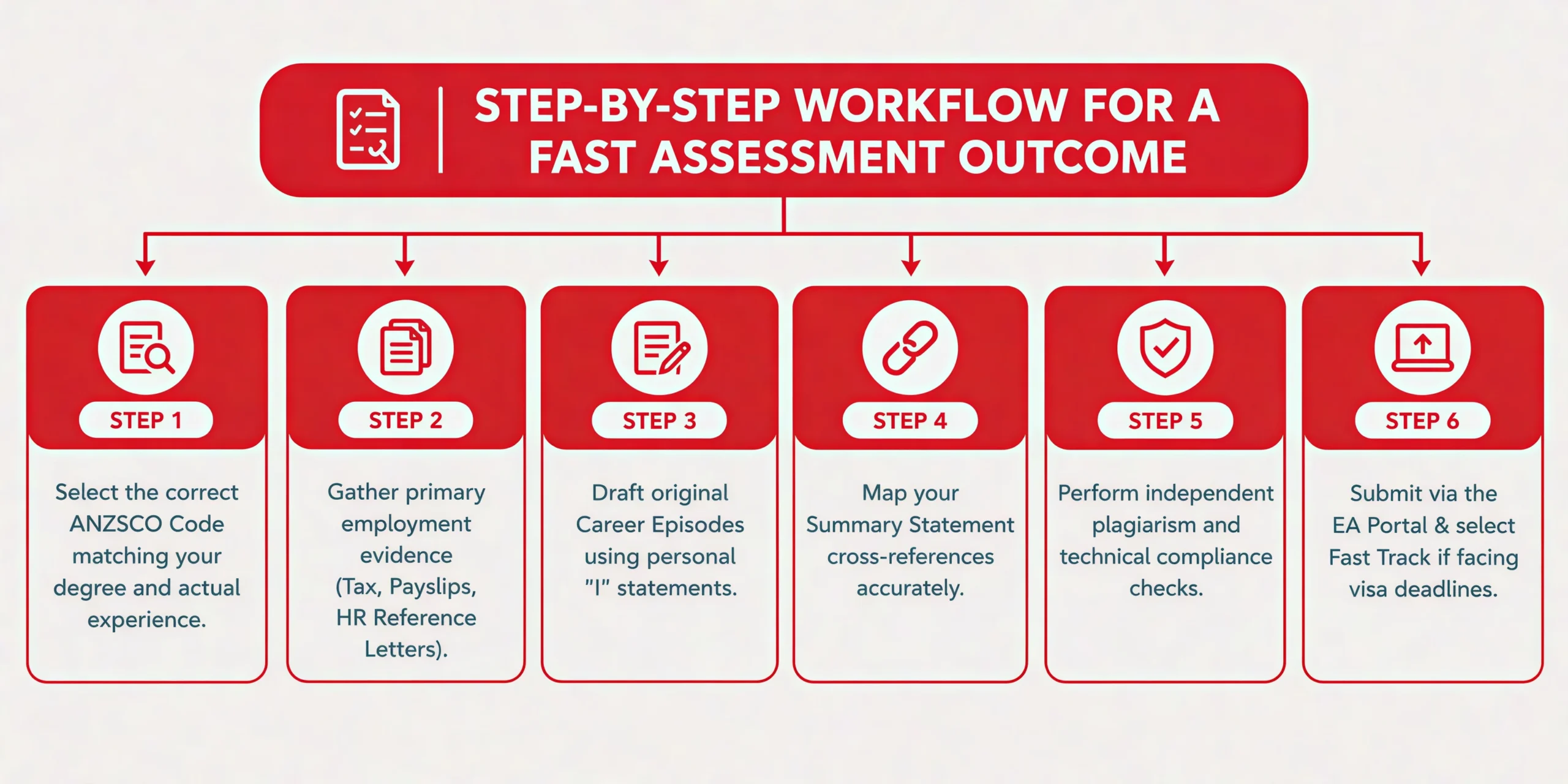
Step 1: Select the Right ANZSCO Target
Examine the official ANZSCO descriptor for your engineering discipline. Ensure that the core duties described in your work reference letters and project narratives align closely with EA’s expected tasks for that occupation code.
Step 2: Assemble Complete Documentary Evidence
Before logging into the portal, gather color scans of original documents:
- Passport identity pages.
- Official degree certificates and academic transcripts.
- Proof of English language proficiency (IELTS, PTE Academic, or TOEFL iBT).
- Detailed work reference letters covering your employment history.
- Third-party primary financial evidence (income tax statements, official pension contribution logs, or consecutive pay slips).
Step 3: Draft High-Quality Career Episodes
Emphasise technical tasks, the software tools you used (e.g., AutoCAD, ETABS, MATLAB, and ANSYS), design calculations performed, safety protocols followed, and innovative problem-solving approaches. Always write in the first-person singular narrative style (“I designed,” “I calculated,” “I investigated”) to make your personal contribution clear.
Step 4: Complete the Summary Statement
The Summary Statement links your written episodes to Engineers Australia’s competency elements. Double-check that every paragraph reference listed in your Summary Statement points directly to a real technical event described in your Career Episodes.
Pro Tip: Writing a compliant Summary Statement can be challenging for busy engineers. Utilizing professional Summary Statement Writing and CPD Writing Services from CDR Report Writers ensures your mapping matrix is accurate and clear.
Step 5: Conduct an Independent Quality Review
Run your drafted report through plagiarism detection tools and check every page against the latest guidelines. Resolving minor errors, missing details, or vague explanations before submission is the single most effective way to avoid processing delays.
7. How CDR Report Writers Secure Fast, Positive Outcomes
Navigating complex skill assessment guidelines while managing career and personal commitments can be difficult. Minor technical errors, weak narrative phrasing, or improper formatting can lead to costly delays or negative results.
CDR Report Writers is a recognized global provider of engineering assessment assistance. Their team of engineering writers and technical editors helps applicants submit fully compliant, high-quality CDR dossiers on their very first attempt.
Here is how their services support your submission timeline:
- 100% Original Content Generation: Every Career Episode is developed from your actual academic and professional engineering projects, ensuring complete originality and zero plagiarism flags.
- End-to-End Dossier Preparation: Comprehensive creation of CPD records, three detailed Career Episodes, and a structured Summary Statement tailored to your ANZSCO code.
- In-Depth Technical Auditing: Rigorous pre-submission reviews that verify every detail against updated Engineers Australia guidelines.
- Expert Handling of Assessor Inquiries: If you submitted on your own and received a Clarification or More Information (MI) request from EA, their team can help you prepare clear, compliant responses to resolve queries quickly.
By partnering with CDR Report Writers, you eliminate guessing games, avoid costly administrative extensions, and present a professional report that moves through assessment queues as efficiently as possible.
8. Conclusion
Managing your Engineers Australia CDR processing time 2026 effectively requires clear planning, high-quality documentation, and a strategic submission approach. While standard queues average 12 to 16 weeks just to reach an assessor, selecting the EA fast track service reduces this initial waiting period to 20 business days.
Avoid unnecessary delays, administrative inquiries, and visa stress. Prepare your documents correctly from the start with expert guidance from CDR Report Writers, and take a confident step toward securing your permanent residency in Australia.
9. Frequently Asked Questions (FAQs)
Q1: What is the average Engineers Australia CDR processing time in 2026?
Standard CDR processing currently takes approximately 12 to 16 weeks (roughly 3 to 4 months) for an assessor to be assigned.
Q2: Does opting for EA Fast Track guarantee an immediate positive outcome?
No. The EA Fast Track service guarantees that an assessor will open and begin evaluating your file within 20 business days. The final decision still depends entirely on whether your report satisfies all competency guidelines, technical standards, and originality requirements.
Q3: How much does the EA fast track service cost in 2026?
The priority fast-track service is an optional upgrade that costs approximately AUD $396, including GST where applicable, in addition to the standard CDR assessment fee.
Q4: Can I upgrade a standard CDR application to fast track after lodging it?
Yes. If you lodged your application under the standard queue and later decide that you need faster turnaround, you can log in to your online Engineers Australia portal account and pay the fast-track fee to upgrade your submission, provided assessment has not already begun.
Q5: What happens if Engineers Australia issues a “More Information” (MI) request?
If an assessor identifies missing documents, unclear reference letters, or structural issues in your report, they will issue an official MI request. Processing stops until you submit the requested details, which typically adds 4 to 8 weeks to your total evaluation timeline.
Q6: How does CDR Report Writers help prevent processing delays?
CDR Report Writers prepares complete, fully compliant, and original CDR dossiers tailored to current Engineers Australia standards.