
Securing professional CDR writing services Australia provides candidate engineers with the strategic and technical framework required to demonstrate their qualifications effectively and secure a positive outcome on the first attempt.
This comprehensive guide breaks down the core elements of the CDR process, examines the specific competencies demanded by Engineers Australia, details common pitfalls to avoid, and demonstrates how specialized CDR writing services for engineers Australia help navigate the complexities of Australian skilled migration.
Understanding the Role of Engineers Australia and the CDR Process
Engineers Australia is the designated assessing authority for engineering occupations in Australia under the Migration Skills Assessment framework.
The Pathways to Migration Skills Assessment
Engineers Australia offers several pathways for qualification assessment:
- Washington Accord Pathway: For candidates holding accredited undergraduate engineering qualifications from recognized signatory countries.
- Sydney Accord Pathway: Designed for engineering technologists holding accredited qualifications from recognized signatory countries.
- Dublin Accord Pathway: Tailored for engineering technicians holding accredited qualifications from recognized signatory countries.
- Competency Demonstration Report (CDR) Pathway: Designed for engineers holding non-accredited qualifications or qualifications from non-signatory countries.
The vast majority of skilled migration applicants from developing or non-member regions must utilize the CDR pathway. This pathway evaluates actual undergraduate engineering projects and academic coursework. Utilizing trusted CDR writing services Australia helps streamline this complex documentation process.
Occupational Categories Assessed by Engineers Australia
Before drafting your Competency Demonstration Report, you must identify your target occupational category as defined by the Australian and New Zealand Standard Classification of Occupations (ANZSCO). Engineers Australia evaluates candidates across four primary occupational profiles:
| ENGINEERS AUSTRALIA OCCUPATIONAL CATEGORIES | ||
|---|---|---|
| Occupational Category | ANZSCO Level | Minimum Qualification Requirement |
| Professional Engineer | Skill Level 1 | 4-year Bachelor’s degree in Engineering |
| Engineering Technologist | Skill Level 1 | 3-year Bachelor’s degree/Diploma in Eng. |
| Engineering Associate | Skill Level 2 | 2-year Advanced Diploma/Associate Degree |
| Engineering Manager | Skill Level 1 | Bachelor’s degree + proven management experience. |
1. Professional Engineer (ANZSCO Unit Group 2339 & others)
A Professional Engineer evaluates engineering problems, applies advanced mathematical and scientific knowledge, manages risk, and leads complex projects. The educational benchmark is a four-year Bachelor of Engineering degree.
2. Engineering Technologist (ANZSCO Code 233914)
An Engineering Technologist focuses on engineering technology within a specific branch, specializing in system applications, plant operations, and technical adaptations. The benchmark is a three-year Bachelor of Technology degree.
3. Engineering Associate (ANZSCO Code 312999)
Engineering Associates usually work as technical support specialists, draftspersons, or testing officers. They focus on established practices, codes, and operational procedures. The required benchmark is a two-year Advanced Diploma or Associate Degree in Engineering.
4. Engineering Manager (ANZSCO Code 133211)
An Engineering Manager formulates engineering strategies, manages major department operational budgets, directs high-level engineering teams, and oversees organizational compliance.
Leveraging professional CDR writing services Australia ensures your documentation targets the exact competency indicators specified for your targeted ANZSCO classification.
Core Components of a Migration-Ready CDR Package
A complete CDR application is not a single document; it is a structured portfolio composed of distinct components. Each document serves a specific purpose in proving your technical eligibility and adherence to Australian standards.
1. Continuing Professional Development (CPD)
The CPD report is a tabular or bulleted document demonstrating how you have maintained and expanded your engineering knowledge after graduation. According to EA guidelines, your CPD must not exceed one page, yet it must effectively cover:
- Formal post-graduate study or short training courses.
- Seminars, workshops, technical conferences, and symposiums attended.
- Preparation and presentation of technical papers, publications, or lectures.
- Service to professional engineering associations, committees, or societies.
- Self-directed study, including technical books, journals, and industry standards reviewed.
Professional CDR writing services Australia ensure your CPD is concisely presented while meeting all formal compliance standards.
2. Three Career Episodes
The Career Episodes form the technical core of your CDR application. Each episode is an essay detailing a specific period of your engineering education or work experience.
- Word Count: Each episode must be between 1,000 and 2,500 words.
- Focus: They must document how you personally applied engineering knowledge to solve technical problems, rather than describing collective team achievements.
- Tone: Written strictly in the first-person active voice (“I calculated,” “I analyzed,” “I designed,” “I evaluated”).
Standard Structure of a Career Episode:
Each Career Episode must follow a four-part structural sequence:
- Introduction (approx. 100 words): States the chronological period, geographic location, organization name, and position title.
- Background (200–500 words): Outlines the project context, organizational structure, project objectives, and your specific job description.
- Personal Engineering Activity (500–1000+ words): The critical section detailing the specific technical work you performed, engineering calculations made, design software used, challenges overcome, and safety/environmental regulations applied.
- Summary (500–1000 words): Concludes with your overall project outcomes, whether targets were met, and your personal contribution to the project’s success.
Expert CDR writing services for Engineers Australia focus heavily on structuring this section to emphasize personal technical accountability.
3. Summary Statement
The Summary Statement is often considered the most challenging component of the CDR portfolio. It is a structured tabular cross-reference that maps specific paragraphs within your three Career Episodes to the 16 core competency elements specified by Engineers Australia.
The competency elements are categorized into three broad pillars:
- Knowledge and Skill Base (Element 1.1 to 1.6)
- Engineering Application Ability (Element 2.1 to 2.4)
- Professional and Personal Attributes (Element 3.1 to 3.6)
An incorrectly formatted or poorly mapped Summary Statement is one of the quickest ways to trigger an assessment request for revisions from Engineers Australia. Using reliable CDR writing services Australia ensures every element is mapped accurately.
4. Curriculum Vitae (CV) / Resume
Your CV must provide a clear summary of your employment history, academic qualifications, and career growth. The EA-compliant resume must include project descriptions, company profiles, key achievements, software proficiency, and clear explanations for any gaps in employment exceeding six months.
Detailed Competency Mapping for Professional Engineers
To help you understand what EA assessors look for within your report narrative, the following table breaks down the key competency units for a Professional Engineer and illustrates how they must be supported in your text:
| Competency Category | Specific Element | Technical Application Required in Narrative |
|---|---|---|
| 1. Knowledge Base | 1.1 Comprehensive, theory-based understanding | Show how basic mathematical, scientific, and engineering fundamentals were used to evaluate a technical problem. |
| 1. Knowledge Base | 1.2 Conceptual understanding of mathematics/stats | Detail complex numerical analyses, finite element modeling (FEM), computational fluid dynamics (CFD), or statistical quality controls. |
| 1. Knowledge Base | 1.3 In-depth engagement with specialist fields | Demonstrate knowledge of domain-specific standards (e.g., AS/NZS codes, ISO frameworks, IEEE guidelines). |
| 2. Engineering Ability | 2.1 Application of established methods | Explain step-by-step methodologies used to execute structural, mechanical, software, or electrical designs. |
| 2. Engineering Ability | 2.2 Fluent application of engineering techniques | List exact software tools used (e.g., AutoCAD, SolidWorks, MATLAB, ETABS, Revit) and explain how you ran simulations. |
| 2. Engineering Ability | 2.3 Application of systematic design processes | Detail design iterations, feasibility studies, risk assessments, cost estimations, and trade-off decisions. |
| 3. Professional Attributes | 3.1 Ethical conduct and professional accountability | Highlight safety compliance, risk management strategies, adherence to building codes, and environmental protection measures. |
| 3. Professional Attributes | 3.2 Effective oral and written communication | Describe presentations, client progress meetings, technical report writing, and stakeholder coordination. |
| 3. Professional Attributes | 3.3 Creative, innovative, and proactive demeanor | Document specific technical innovations, workarounds, or process optimizations you introduced to overcome delays or errors. |
Common Reasons for CDR Rejection by Engineers Australia
Understanding why candidates fail their Migration Skills Assessment helps highlight the value of professional CDR writing services Australia. Engineers Australia assessors strictly flag reports for several reasons:
1. Plagiarism and Copying (Zero Tolerance)
Engineers Australia utilizes sophisticated plagiarism detection software (including Advanced Turnitin and AI detection algorithms). Copying content from internet templates, sample CDRs, or past successful candidates leads to immediate application rejection, notification to the Department of Home Affairs, and a mandatory 12-to-36-month assessment ban.
2. Excessive Focus on Group Achievements
Writing phrases like “We conducted the site survey,” “Our team designed the circuit,” or “We managed the project budget” makes it impossible for the assessor to measure your engineering contribution. The narrative must highlight your individual responsibility using phrases like “I calculated,” “I conducted,” and “I designed.”
3. Lack of Engineering Calculations and Problem Solving
A CDR should not read like a general management summary or descriptive project report. Assessor teams expect technical substance: exact formulas, stress-strain calculations, fluid flow dynamics, thermal balance equations, budget variance formulas, or algorithm design choices.
4. Poor Formatting and Structural Errors
Failing to follow the section numbering system mandated by the EA MSA Booklet (e.g., numbering Career Episode 1 as CE 1.1, CE 1.2, CE 1.3, etc.) creates confusion during cross-referencing in the Summary Statement.
5. Ignoring Australian and International Standards
Engineers in Australia operate under strict regulatory frameworks. Failing to mention relevant Australian Standards (AS/NZS), ISO standards, or equivalent regional technical codes makes your work appear non-compliant with local industry practice.
Why Professional CDR Writing Services Australia Are Essential
Drafting an EA-compliant CDR while managing full-time professional or academic responsibilities can take months of effort. Utilizing trusted CDR writing services for engineers Australia provides crucial strategic, linguistic, and technical advantages:
1. Domain-Specific Engineering Expertise
Experienced CDR writing services Australia employ technical writers with actual degrees across various engineering disciplines, including Civil, Mechanical, Electrical, Chemical, Biomedical, Structural, Environmental, and Software Engineering. This ensures that the technical details, software references, and calculations in your report are accurate and realistic.
2. Full Compliance with the Latest MSA Guidelines
Engineers Australia periodically updates its Migration Skills Assessment Booklet. Professional writing services maintain up-to-date knowledge of policy shifts, formatting changes, and emerging assessor preferences, keeping your application compliant.
3. Guaranteed Original, Plagiarism-Free Content
Professional services write your report from scratch based on your real-world academic projects and career experience. Every draft is subjected to multi-layered quality control and strict plagiarism checks before delivery.
4. Flawless Technical English
For candidates whose primary language is not English, communicating complex engineering concepts clearly in Australian English can present a hurdle. Expert CDR writing services Australia ensure your technical ideas are presented with strong grammar, active phrasing, and clear professional prose.
The Step-by-Step Methodology at CDR Report Writers
At CDR Report Writers, our process is built around clarity, technical depth, and strict quality controls. Here is how we turn your practical achievements into an EA-ready application:
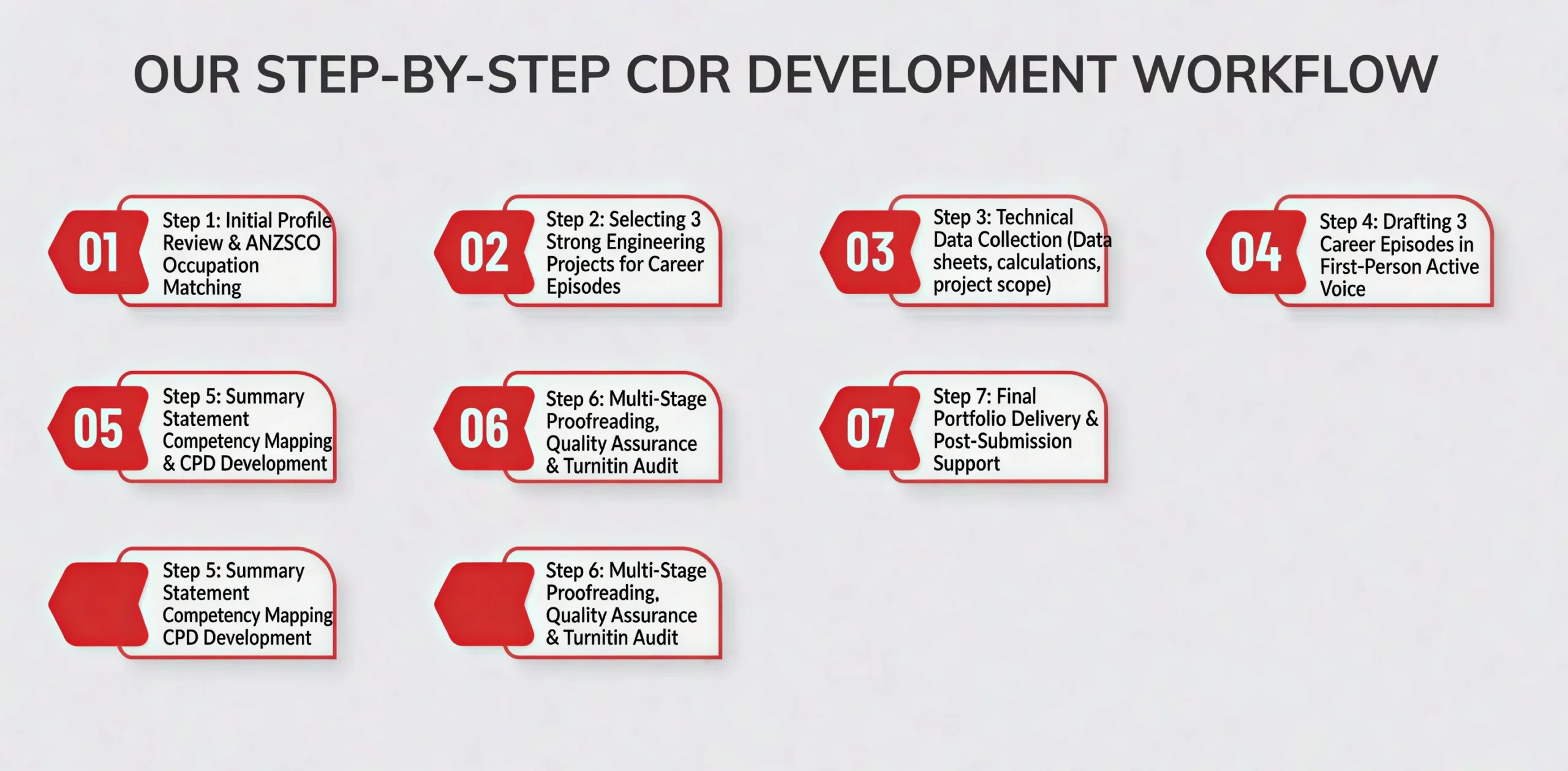
Step 1: Profile Evaluation & ANZSCO Selection
We analyze your academic transcripts, degree credentials, and work history to select the most suitable ANZSCO occupational title (Professional Engineer, Technologist, Associate, or Manager).
Step 2: Project Identification & Data Collection
Not all career projects make suitable Career Episodes. We help you choose three major projects that feature significant technical challenges, problem-solving opportunities, and engineering design.
We gather project documentation, drawings, software details, and performance metrics through targeted questionnaires.
Step 3: Drafting the Career Episodes
Our technical engineering writers craft three unique, detailed Career Episodes. We focus on framing your personal contributions, design choices, calculations, software applications, and compliance with safety and environmental standards.
Step 4: Summary Statement & CPD Development
Once the Career Episodes are complete, we create your Continuing Professional Development (CPD) record and carefully construct your Summary Statement. Every sub-element is cross-referenced back to specific, numbered paragraphs in your episodes.
Step 5: Quality Assurance & Plagiarism Verification
Before final delivery, your full CDR package undergoes rigorous proofreading. We run the text through advanced plagiarism and AI checks to ensure complete original content.
Discipline-Specific Advice for Popular Engineering Fields
Different engineering disciplines require different technical highlights within their Career Episodes. Here is a breakdown of key focus areas across major branches:
| Discipline | Essential Technical Focus Areas in Career Episodes |
|---|---|
| Civil | Structural calculations, concrete/steel design (AS 3600/AS 4100), geotechnical surveys, hydrology models, site safety, and quality plans. |
| Mechanical | HVAC duct sizing, CAD modeling, thermal load analysis, FEA stress calculations, pump selection, fluid mechanics, material selection. |
| Electrical | Single-line diagrams, short-circuit calculations, transformer sizing, PLC/SCADA programming, switchgear layout, National Electrical Codes. |
| Software | System architecture design, database normalization, algorithm complexity evaluation, CI/CD pipelines, API security, automated testing methods. |
Civil Engineering (ANZSCO 233211)
Highlight structural design calculations, geotechnical soil evaluations, material testing, fluid mechanics for stormwater drainage, and environmental impact studies. Mention reliance on Australian Standards like AS 3600 (Concrete Structures) or AS 4100 (Steel Structures).
Mechanical Engineering (ANZSCO 233512)
Emphasize thermodynamics, HVAC load calculations, finite element analysis (FEA), fluid dynamics, CAD design, machine component selection, maintenance scheduling, and workplace health and safety (WHS) protocols.
Electrical Engineering (ANZSCO 233311)
Focus on power system distribution, high-voltage equipment selection, control system design, circuit protection calculations, PLC/SCADA programming, and compliance with electrical safety standards.
Software Engineering (ANZSCO 261312)
Highlight software development lifecycles (SDLC), algorithm design, data structure choices, API design, cloud deployment infrastructure, code refactoring, system security, and performance testing frameworks.
Conclusion
Securing a positive Migration Skills Assessment from Engineers Australia is the single most critical bridge between your engineering qualification and a thriving professional career in Australia. While the CDR process demands absolute technical accuracy, strict adherence to the MSA Booklet, and flawless competency mapping, you do not have to navigate it alone.
By leveraging expert CDR writing services Australia, you transform your real-world engineering accomplishments into a polished, EA-compliant narrative that eliminates the risks of plagiarism, structural errors, or delays.
Take full control of your migration journey, partner with dedicated specialists at cdrreportwriters today, and secure your positive assessment on the very first try.
Frequently Asked Questions About CDR Writing Services
Q1: How long does it take to draft a complete CDR package?
Developing a full CDR package, including three Career Episodes, the Summary Statement, CPD, and CV, typically takes between 2 to 4 weeks depending on the availability of project details and data. Express delivery options are often available for urgent deadlines.
Q2: Can I use academic projects from my university degree for Career Episodes?
Yes. Engineers Australia accepts projects completed during your undergraduate studies as a basis for Career Episodes. However, for those applying as experienced Professional Engineers, including at least two major real-world workplace projects is strongly recommended.
Q3: What happens if Engineers Australia asks for revisions?
If EA assessors request additional information or revisions (commonly referred to as a “Comment” or “Notification”), professional CDR writing services Australia provide post-submission support to help analyze the assessor’s feedback, update the narrative, and resubmit your package.
Q4: Is it safe to use CDR writing assistance online?
Working with a reputable service like CDR Report Writers is entirely safe and effective. Our services provide expert guidance, professional structuring, and tailored drafting based on your real-life career experience, ensuring full compliance with EA guidelines and ethics rules.