
Administered and evaluated by Engineers Australia (EA), the official assessing authority designated by the Australian Government for engineering occupations, your CDR serves as verifiable evidence that your academic qualifications, technical knowledge, and practical engineering experience meet strict Australian industry standards.
Fulfilling CDR requirements demands a deep understanding of formatting rules, technical reporting criteria, and ethical guidelines. Whether you are a civil, mechanical, electrical, or software engineer, meeting Engineers Australia CDR requirements requires meticulous planning, absolute authenticity, and alignment with the official Migration Skills Assessment guidelines.
This comprehensive guide covers everything you need to know about CDR report requirements, supporting document protocols, English language rules, common reasons for rejection, and step-by-step strategies for a positive outcome.
1. What is a Competency Demonstration Report (CDR)?
A Competency Demonstration Report (CDR) is an extensive portfolio of technical writing and professional evidence submitted to Engineers Australia. It is specifically designed for foreign applicants whose engineering qualifications are non-accredited, meaning they were earned at institutions not covered by international qualification agreements such as the Washington Accord, Sydney Accord, or Dublin Accord.
Unlike academic assessments that check degree titles, a CDR evaluates your ability to apply engineering knowledge to real-world problems, navigate design constraints, manage risks, and communicate technical solutions effectively.
Occupational Categories Assessed by Engineers Australia
Before drafting your report, you must align your CDR with one of the four occupational categories recognized by EA under the Australian and New Zealand Standard Classification of Occupations (ANZSCO):
- Professional Engineer (ANZSCO Unit Group 2339 / Specific Fields): Requires a minimum 4-year Bachelor of Engineering degree. Focuses on systemic design, technological innovation, structural analysis, project management, and high-level problem-solving.
- Engineering Technologist: Requires a minimum 3-year Bachelor of Engineering Technology degree. Focuses on applying established and emerging technologies, adapting engineering techniques, and managing practical technical operations.
- Engineering Associate: Typically requires a 2-year Advanced Diploma or Associate Degree. Focuses on practical technical support, testing, drafting, code compliance, and routine operational procedures.
- Engineering Manager: Requires a 4-year engineering degree plus extensive high-level management experience. Focuses on strategic leadership, policy formulation, financial administration, and department management.
2. Core Structure of a CDR Submission
To satisfy CDR submission requirements, your portfolio must contain three main technical sections, surrounded by complete personal and employment documentation. Omitting sections, failing to map competencies, or altering the report layout leads to assessment delays or outright rejection.
Engineering professionals who want to ensure their document setup strictly follows official guidelines can rely on expert CDR Writing Services to build a compliant portfolio from scratch.
3. Deep Dive into CDR Components and Technical Rules
A. Continuing Professional Development (CPD)
The CPD demonstrates your commitment to remaining current with technological and methodological developments in your engineering discipline following your graduation.
- Formatting Rules: Must be presented in a clean table strictly limited to one A4 page.
- Content Parameters: You must include the course or activity title, date, duration (in hours), location, and the organizing body.
- Eligible Activities:
- Formal post-graduate study programs or short courses.
- Technical workshops, seminars, webinars, and industry conferences attended.
- Active involvement in engineering societies or committees.
- Self-study of engineering manuals, journals, and standards.
B. The Three Career Episodes (CEs)
Career Episodes form the central core of CDR requirements in Australia. Each Career Episode is an original narrative detailing a distinct period of engineering work or a specific project.
Each Career Episode must contain between 1,000 and 2,500 words and follow a precise four-part paragraph hierarchy:
Standard Career Episode Layout:
| Section | Target Word Count | Required Technical Focus |
|---|---|---|
| 1. Introduction | ~100 words | Chronological dates, project duration, geographic location, employing organization, and your exact job title. |
| 2. Background | 200–500 words | Project context, objectives, organizational chart showing your position, and your assigned scope of work. |
| 3. Personal Engineering Activity | 500–1,000 words | The primary core. Technical tasks performed, calculations made, software tools used, challenges solved, and safety standards applied. |
| 4. Summary | 50–100 words | Final project evaluation, whether goals were achieved, and personal reflections on your individual engineering contributions. |
If you are struggling to isolate your personal technical tasks or write in active voice, working with specialists in Career Episode preparation and writing ensures your technical reports meet Engineers Australia standards without revision delays.
C. The Summary Statement (SS)
The Summary Statement maps the engineering activities described in your Career Episodes to the official Stage 1 Competencies of Engineers Australia.
You must download and complete the exact Summary Statement template matching your nominated occupational category (Professional Engineer, Engineering Technologist, Engineering Associate, or Engineering Manager). In this cross-referencing matrix, you point specific competency elements to exact numbered paragraphs in your episodes (e.g., CE 1.3, CE 2.5, CE 3.2).
Primary Competency Units Assessed:
- Knowledge and Skill Base: Engineering fundamentals, advanced technical knowledge, and mathematical analysis.
- Engineering Application Ability: Systematic design processes, technical synthesis, and project execution.
- Professional and Personal Attributes: Ethical conduct, risk management, team leadership, and communication skills.
Utilizing dedicated guidance for Professional Summary Statement mapping helps ensure every sub-element is accurately linked to solid evidence across your three episodes.
4. Essential Supporting Document Checklist
Satisfying CDR report requirements requires a clean documentation package alongside your written narratives. All files submitted through the EA online portal must be high-resolution color scans (minimum 300 dpi) of original documents. Certified black-and-white copies or blurry photos will be rejected.
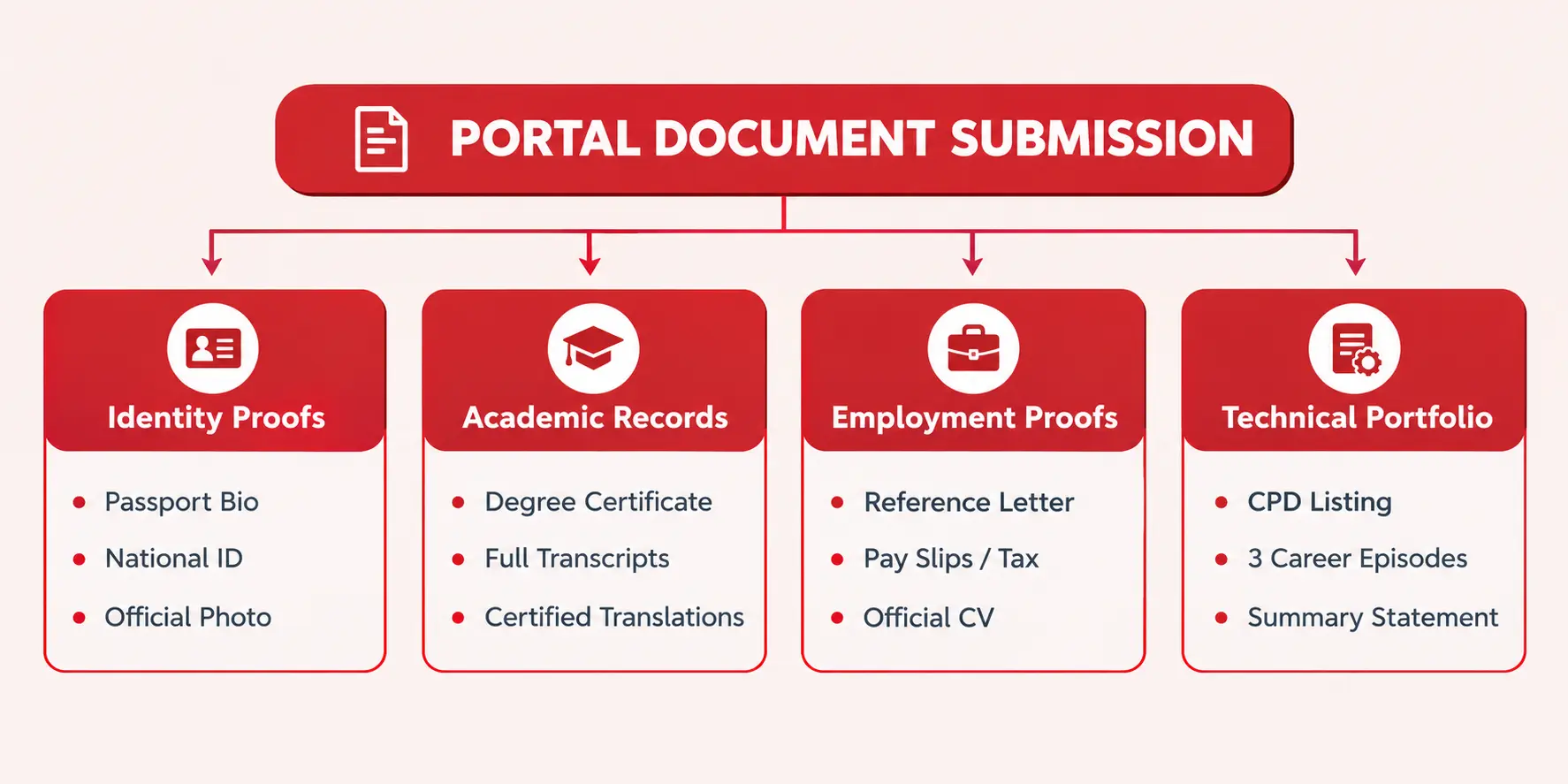
- Identity Credentials: Passport bio-page, official national identity card, and legal name change documentation (if applicable).
- Academic Evidence: Original degree certificate, official academic transcripts, and course syllabi (for non-standard degrees). Non-English documents must include certified English translations.
- Employment Verification: Letters must detail exact start/end dates, job titles, duty breakdowns, and supervisor contact info. Official tax records, bank statements showing salary credits, or Social Security statements are required as secondary proof.
- Curriculum Vitae (CV): A structured resume covering your educational history and employment background. Any gaps in employment exceeding three months must be explicitly explained.
5. English Language Proficiency Criteria
Demonstrating English language competence is a mandatory prerequisite under Engineers Australia CDR requirements. Test scores must be valid at the time of application submission.
Approved English Tests and Minimum Score Thresholds:
| Test Format | Listening | Reading | Writing | Speaking | Score Validity |
|---|---|---|---|---|---|
| IELTS Academic or General | 6.0 | 6.0 | 6.0 | 6.0 | 2 Years |
| PTE Academic | 50 | 50 | 50 | 50 | 2 Years |
| TOEFL iBT | 12 | 13 | 21 | 18 | 2 Years |
Exemption Criteria:
Applicants can claim an English test exemption under two conditions:
- Holding a passport and citizenship from an approved English-speaking country: United Kingdom, United States, Canada, New Zealand, or the Republic of Ireland.
- Successful completion of an accredited undergraduate engineering degree or a minimum 2-year Master’s/PhD program at an Australian university.
6. Major Pitfalls Leading to Assessment Rejection
Meeting Engineers Australia CDR requirements means avoiding errors that flag integrity breaches or technical shortcomings. The primary reasons for negative assessment outcomes include:
- Plagiarism and Generative AI Content: EA screens every application using anti-plagiarism engines like Turnitin. Using online samples, copying from peers, or using AI text generators results in rejection, formal notification to the Department of Home Affairs, and a 12- to 36-month assessment ban.
- Team-Centric Language: Writing “We installed…” or “The team developed…” makes it impossible for the assessor to isolate your specific technical skills. Use “I” to describe your personal tasks.
- Omitting Technical Calculations and Design Work: Career Episodes focusing only on project management, meeting scheduling, or site inspection will fail to demonstrate Stage 1 Competencies. Include engineering calculations, software tools used, design parameters, standards applied, and technical problem-solving.
- Discrepancies Between CV and Reference Letters: Inconsistent dates, title mismatches, or conflicting job responsibilities across your CV, reference letters, and tax records raise immediate authenticity concerns.
To protect your submission from integrity flags or structural mistakes, running a pre-submission Plagiarism and AI Audit or hiring professional CDR Review & Proofreading Services helps ensure your application is audit-ready.
Professional Support for Your CDR Application
Navigating the detailed requirements of an Engineers Australia assessment demands technical precision, deep familiarity with MSA guidelines, and strict ethical alignment. If you are looking for professional guidance, explore the dedicated solutions available at cdrreportwriters:
- Complete CDR Writing Services: Custom-written Career Episodes, CPD lists, and Summary Statements tailored to your specific engineering field and built strictly from your authentic workplace projects.
- CDR Review & Proofreading Services: A comprehensive technical evaluation of your draft to correct grammar, align with word count limits, fix structural issues, and polish the narrative into active, first-person prose.
- Plagiarism and AI Audit: Pre-submission screening using advanced detection software to guarantee your report is 100% original and fully compliant with EA integrity policies.
- Summary Statement Cross-Mapping: Accurate cross-referencing to ensure every Stage 1 Competency element links to specific evidence in your Career Episodes.
Conclusion
Fulfilling CDR requirements is the single most critical step for non-accredited foreign engineers pursuing skilled migration to Australia. A successful Competency Demonstration Report requires more than proving you hold an engineering qualification; it demands a structured demonstration of how you apply technical knowledge, solve complex engineering problems, manage operational risks, and maintain ethical standards within professional environments.
By systematically constructing your single-page CPD, writing three first-person Career Episodes based on genuine technical work, mapping your achievements in a Summary Statement, and providing verified primary documentation, you satisfy Engineers Australia CDR requirements.
Frequently Asked Questions (FAQs)
1. How long does Engineers Australia take to process a CDR assessment?
Standard processing times for a standard CDR assessment typically range from 8 to 12 weeks. However, if you purchase the Fast Track Service through the EA online portal, processing is reduced to approximately 15 to 20 business days. Processing may take longer if document requests or clarifications are issued.
2. Can I submit academic projects in my Career Episodes?
Yes. If you lack sufficient professional work experience, you may use major academic projects completed during your undergraduate engineering degree. However, these projects must demonstrate high-level technical application, calculations, design work, and problem-solving, rather than basic lab exercises.
3. What happens if Engineers Australia detects plagiarism or AI content in my CDR?
Engineers Australia maintains a strict zero-tolerance policy regarding plagiarism and AI generation. If Turnitin or internal assessment checks flag your CDR, your application will be rejected, your fee forfeited, and a 12- to 36-month ban imposed on your profile. EA may also notify the Australian Department of Home Affairs.
4. Is work experience mandatory for a positive CDR assessment?
No, relevant skilled work experience is not strictly mandatory for a basic Stage 1 Skills Assessment if you hold a recognized engineering qualification. You can complete your Career Episodes using academic work. However, professional work experience is required if you also apply for Relevant Skilled Employment (RSE) assessment for visa points.
5. What is the difference between Stage 1 and Stage 2 assessment?
Stage 1 Assessment: Evaluates your entry-level engineering qualifications and competencies for migration eligibility and ANZSCO occupation classification.
Stage 2 Assessment: Evaluates advanced, practical engineering experience for professionals seeking Chartered status (CPEng) or registration on the National Engineering Register (NER) in Australia.
6. Can I apply under a different occupational category than my degree title?
Yes, provided your technical experience and Career Episodes demonstrate competencies aligned with the requested ANZSCO code. EA assesses your actual demonstrated engineering competencies rather than your degree title alone.