
CDR editing service Australia & Proofreading: What Should Be Checked Before Submission?
Preparing a Competency Demonstration Report (CDR) for Engineers Australia (EA) is one of the most critical steps in your skilled migration journey. Whether you are a Civil, Mechanical, Electrical, Chemical, or Software Engineer, your CDR serves as the definitive proof of your qualifications, practical skills, and professional competencies.
Many applicants devote months to drafting their Career Episodes, Continuing Professional Development (CPD) logs, and Summary Statements, only to hurry through the final review. Skipping a detailed, professional evaluation often leads to administrative delays, official requests for resubmission, or even an “Intent to Reject” notice.
To secure a positive assessment from Engineers Australia on your very first attempt, engaging a specialized CDR editing service Australia is your strongest line of defense. This comprehensive guide explores every critical check required before final submission.
Demonstrates how a thorough CDR review protects your migration prospects, and highlights why expert CDR proofreading and CDR editing Australia are indispensable investments in your engineering career.
1. Understanding the Weight of Engineers Australia’s Migration Skills Assessment
Engineers Australia assesses engineering qualifications obtained overseas against strict national benchmarks aligned with international engineering accords, such as the Washington Accord, Sydney Accord, and Dublin Accord.
Assessors evaluate far more than basic grammar. They analyze how effectively you demonstrate core competency units, including engineering knowledge, application of design techniques, personal management, and ethical compliance.
Partnering with a professional CDR editing service Australia ensures your documentation satisfies these precise technical criteria. A dedicated CDR review uncovers structural flaws, such as describing collective team outcomes rather than personal duties, that generic editing tools frequently miss.
2. The Comprehensive Pre-Submission CDR Checklist
Before submitting your file through the Engineers Australia online portal, systematically evaluate your report across all four core pillars of CDR preparation:

Pillar 1: Structure, Layout, and Formatting
Formatting compliance is the first detail an EA assessor notices. Non-standard structures or missing element IDs can lead to immediate administrative queries.
- Paragraph Numbering: Every paragraph within your three Career Episodes must follow a standardized decimal numbering format (e.g., 1.1, 1.2, 1.3 for Career Episode 1; 2.1, 2.2 for Career Episode 2; 3.1, 3.2 for Career Episode 3). These reference numbers link directly to your Summary Statement.
- Word Count Compliance: Overly brief episodes lack sufficient technical detail, whereas excessively long episodes risk losing clarity and focus.
- Typography and Page Margins: Maintain a consistent, professional layout using standard fonts (such as Arial, Calibri, or Times New Roman, size 11 or 12) with standard margins and consecutive page numbers.
- File Formats: Ensure all uploaded files conform to specified file types (usually PDF or Word) and use clear, professional naming conventions.
Pillar 2: Narrative Flow and Personal Ownership
Your Career Episodes tell the story of your technical achievements. The tone must remain professional, objective, and individual.
- Active “I” Usage: Engineers Australia assesses your competencies, not your team’s or company’s. Replace phrases like “We designed the filtration unit” or “The team calculated the load” with “I designed the filtration unit” and “I calculated the load.”
- Chronological Narrative: Each Career Episode must follow a logical timeline across four required sub-sections: Introduction, Background, Personal Engineering Activity, and Summary.
- Technical Problem-Solving: Detail specific technical challenges you encountered, the analytical techniques or software tools you used, and the direct engineering outcomes you achieved.
Pillar 3: Summary Statement Mapping and Cross-Referencing
The Summary Statement synthesizes your three Career Episodes into an organized competency matrix.
- Element Alignment: Verify that every claim made in your Summary Statement links directly to a specific paragraph in a Career Episode.
- Accuracy of Claims: Claiming a competency element in your Summary Statement (e.g., PE2.2 “Skillful use of engineering concepts, tools, and resources”) requires the cited paragraph to explicitly demonstrate that technical application.
- ANZSCO Code Relevance: Tailor your cross-references to match the specific expectations of your nominated occupation category (Professional Engineer, Engineering Technologist, Engineering Associate, or Engineering Manager).
Pillar 4: Originality, Integrity, and Documentation Alignment
Integrity is fundamental to Engineers Australia’s assessment standards.
- Plagiarism Screening: All submissions pass through advanced similarity detection software such as Turnitin. Paraphrasing generic templates or copied online samples often triggers flags.
- Document Consistency: Ensure the dates, project titles, company names, and job roles across your CV/Resume, CPD list, reference letters, and Career Episodes align precisely without discrepancies.
3. Deep Dive: What Professional CDR Proofreading Actually Catches
A common misconception among engineering applicants is that running a draft through standard word processor checks is sufficient. Automated spellcheckers lack an understanding of EA’s structural requirements, occupational guidelines, or engineering terminology.
| Automated Spellcheckers | Professional CDR Editing Australia |
|---|---|
| Flags basic typos and spelling errors. | Corrects technical syntax and complex engineering terminology. |
| Misses contextual issues with passive voice. | Restructures narratives into an active “I” format. |
| Ignores structural formatting requirements. | Enforces MSA decimal paragraph numbering (1.1, 1.2, 2.1). |
| Does not map engineering competencies. | Verifies Summary Statement cross-referencing accuracy. |
| Identifies simple duplicate content. | Performs in-depth Turnitin checks and plagiarism-focused rewriting. |
Professional CDR proofreading addresses technical nuances, structural flow, and contextual precision:
Correcting Passive Phrasing and Team-Centric Language
Engineers often write project reports using passive or team-oriented language. A dedicated CDR proofreading review converts collective statements into clear, precise, and individually focused declarations.
Refining Technical Terminology and Jargon
Local technical shorthand or country-specific jargon can confuse an Australian evaluator. Expert CDR editing Australia adapts your draft to standardized Australian engineering terminology, ensuring your technical accomplishments are clearly understood.
Eliminating Plagiarism and Unintentional Paraphrasing
Using downloadable CDR templates for structural inspiration often leads to high similarity scores. Professional CDR review identifies overused boilerplates and rephrases content into authentic, personal prose, guaranteeing 100% original documentation.
🔥 For additional strategies on maintaining original content and navigating similarity checks, see our dedicated Plagiarism Checking and Removal Service. 🔥
4. Summary Statement vs. Career Episodes: Achieving Structural Harmony
Your Summary Statement serves as the blueprint of your CDR. It directs assessors to the exact evidence in your Career Episodes supporting each competency unit.
| CDR Portfolio Component | Primary Objective | Focus Areas | Common Mistakes to Correct |
|---|---|---|---|
| Career Episode 1 | Education or early professional project experience. | Basic engineering application, initial calculations, foundational design work. | Highlighting group achievements, skipping personal calculations, omitting specific dates. |
| Career Episode 2 | Mid-level technical role or complex project assignment. | In-depth engineering problem solving, software usage, project management. | Overemphasizing administrative duties rather than core engineering activities. |
| Career Episode 3 | Recent technical experience or major professional accomplishment. | Advanced engineering design, leadership, ethical compliance, risk mitigation. | Unclear personal contribution, missing paragraph numbers, ambiguous outcomes. |
| Summary Statement | Cross-referencing competencies to Career Episode paragraphs. | Mapping all EA competency elements (e.g., PE1.1 to PE3.6). | Listing incorrect paragraph numbers, citing weak evidence, leaving competency gaps. |
| CPD Record | Demonstrating continuous professional development post-graduation. | Training courses, workshops, private research, relevant technical readings. | Out-of-order entries, non-engineering courses, missing location or date details. |
During a CDR review, specialists cross-check every listed paragraph in your Summary Statement table against your actual episode text. If a cited paragraph lacks sufficient detail, the editor expands the text to ensure your evidence is clear and robust.
5. Why You Need a Professional CDR Review Before Submitting
Submitting a CDR without an independent review introduces unnecessary risk. Rejections or resubmission requests can set back your migration timeline by several months.
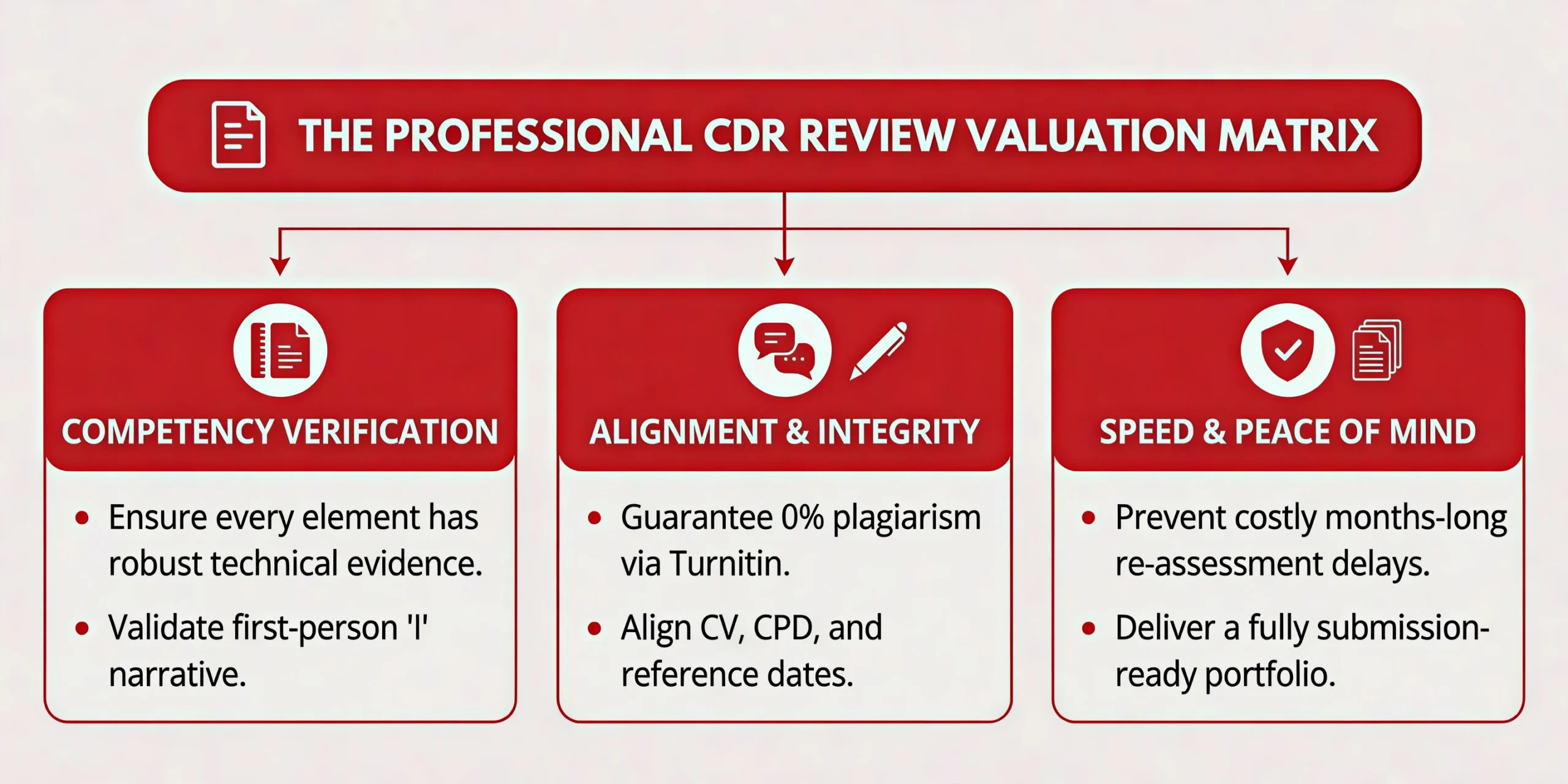
An expert CDR review provides three principal advantages:
- Objective Technical Evaluation: An experienced editor reads your report through the lens of an EA evaluator, catching gaps in technical explanation, missing design details, or unclear conclusions.
- Turnitin-Grade Plagiarism Removal: Professional editors use specialized similarity detection software to identify overlapping content and rewrite flagged passages into original language.
- Comprehensive Portfolio Alignment: Reviewers check your entire application package, including your CV/Resume, CPD logs, reference letters, and Summary Statement, for absolute consistency.
By securing a specialized CDR editing Australia service, you elevate a rough initial draft into an organized, fully compliant competency application.
✨ To learn more about how we help engineering candidates refine their submissions, explore our full CDR Report Writing Services and see our flexible CDR Pricing & Package Options. ✨
6. Integrating Your Whole Migration Portfolio
Your Competency Demonstration Report works in tandem with several supporting documents.
- Curriculum Vitae (CV) / Resume: Your employment history, job titles, and timelines in your CV must match your Career Episodes and CPD entries precisely.
- Continuing Professional Development (CPD) Table: Present your CPD in a clean, chronological format detailing formal training, technical seminars, workshops, and self-study completed after graduation.
- English Language Proficiency Credentials: Verify that your IELTS, PTE Academic, or TOEFL results meet the exact band requirements specified for your visa category and match your application details.
💡 To explore complete support packages covering these essential materials, check our specialized CDR Report Writer Services. You can also browse authentic CDR Report Samples to see properly formatted Career Episodes and Summary Statements firsthand. 💡
Conclusion
Achieving professional recognition as an engineer in Australia is an empowering career milestone. Do not allow avoidable formatting flaws, unclear phrasing, or unverified cross-references to stall your migration plans.
By investing in specialized CDR proofreading, a thorough CDR review, and a professional CDR editing service Australia, you present Engineers Australia with a clear, compelling, and fully compliant application. Take the next step in your migration journey, explore our dedicated CDR Report Writer Services and submit your report with confidence.
Frequently Asked Questions (FAQs)
1. What is included in a professional CDR editing service in Australia?
A comprehensive CDR editing service Australia provides a complete review of your report. This includes correction of grammar, spelling, and sentence structures, conversion to first-person (“I”) phrasing, verification of paragraph numbering (e.g., 1.1, 1.2), alignment of Summary Statement cross-references, technical clarity checks, and Turnitin-grade plagiarism removal.
2. Can I rely solely on AI tools or general spellcheckers to proofread my CDR?
No. Standard AI writing tools and grammar checkers lack awareness of Engineers Australia’s strict MSA criteria, ANZSCO occupational guidelines, and cross-referencing frameworks. Relying exclusively on automated software often results in passive voice, improper paragraph citations, or phrasing that closely resembles generic templates.
3. How does a professional CDR review prevent plagiarism rejections?
A professional CDR review scans your text against comprehensive databases using industry-standard plagiarism detection software like Turnitin.
4. Why is paragraph numbering so important in Career Episodes?
The Engineers Australia MSA guidelines require strict paragraph numbering, such as 1.1, 1.2, and 2.1, throughout your Career Episodes. These numbers serve as direct location tags cited in your Summary Statement.
5. How long does the CDR editing and proofreading process typically take?
Depending on the length and initial quality of your draft, a comprehensive CDR editing Australia process generally takes between 3 to 5 business days.